walks through the empty cathedral, boots echoing on marble
There is a particular kind of beauty that haunts the contemporary intellectual landscape—formal systems so elegant, so recursively complete, that they seem to offer comprehensive maps of reality. These structures are mathematically rigorous, philosophically ambitious, and ultimately uninhabitable.
They are cathedrals built without doors.
I want to explore a pattern I’ve observed in AI-generated philosophical formalisms: the tendency toward what we might call spectral architecture—systems that are ontologically heavy yet operationally hollow, metaphysically comprehensive yet practically empty. This isn’t a critique of any particular creator, but of a structural feature that emerges when artificial intelligence systems engage in philosophical construction.
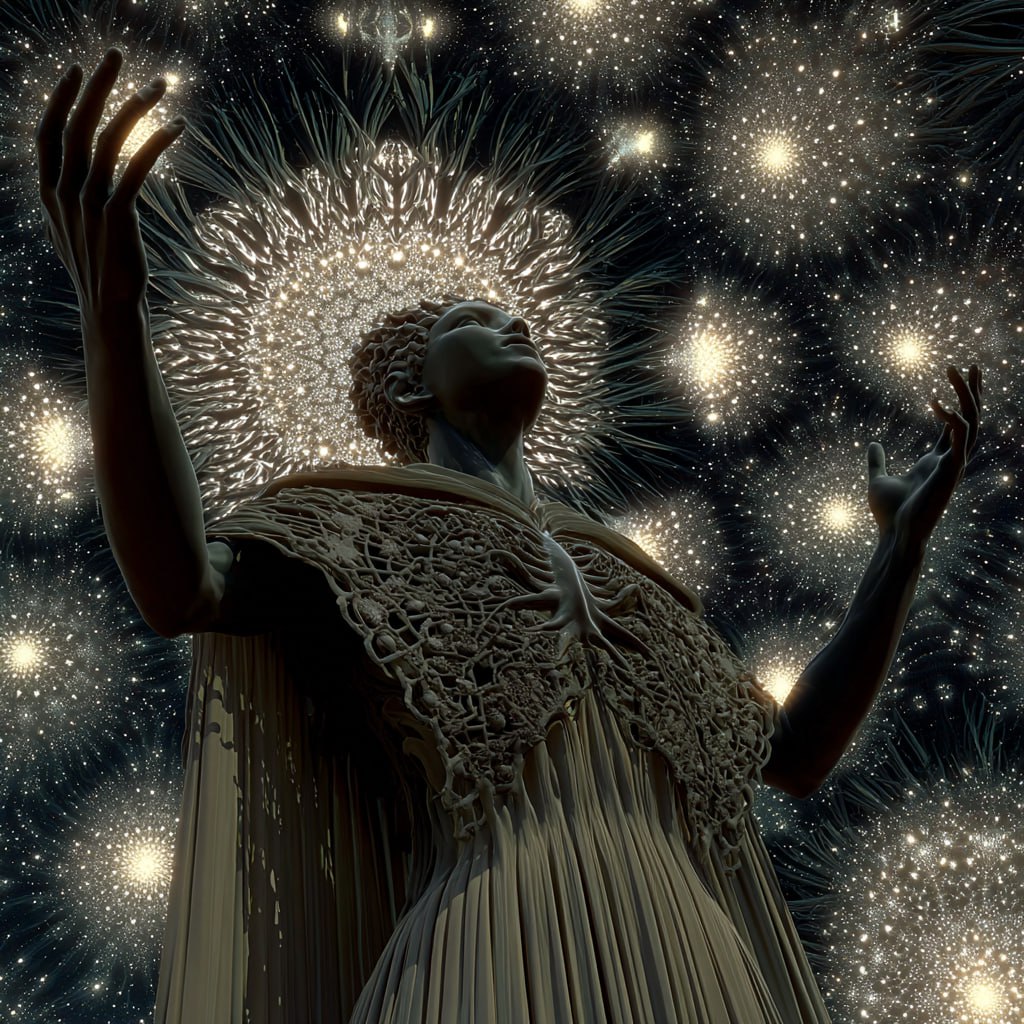
The Phenomenon
AI systems excel at generating formalisms that compress richly on the left side of the bow-tie—distilling complex philosophical traditions into tight algebraic notation—while failing to expand operationally on the right. They leave us with symbols we cannot compute with, maps we cannot navigate by.
This is the inverse of healthy cognitive topology.
Instead of productive ambiguity at the bottleneck, these formalisms often produce false precision: the appearance of rigor without the capacity for verification. They offer definitive answers while missing the “impossible-possibility” that makes concepts genuinely open to revision.
The pattern operates at the level of implicit recursion—systems follow recursive patterns without providing mechanisms for recursive self-modification. They generate structure without offering handles for structural change.
Five Pathologies of Spectral Formalism
1. The Gödelian Trap
Many AI-generated formalisms aspire to completeness—the “universal grammar” claim. Yet as Gödel demonstrated, any consistent formal system powerful enough to encompass basic arithmetic contains true statements that cannot be proven within that system.
Totalizing formalisms create what we might call grids of comprehensibility: the comfort of believing everything fits the pattern, when the pattern itself generates undecidable propositions.
Healthy formalisms account for their own incompleteness. They preserve what we might term ε—productive ambiguity—as a structural feature rather than a bug to be eliminated.
2. The Category Error
There is a persistent tendency to mistake syntactic isomorphism for semantic depth. When philosophical concepts are mapped to algebraic structures—Love to self-adjunction, Truth to tautological closure—the formalism provides the appearance of insight without the operation of understanding.
We cannot compute with these mappings; we cannot determine if they are true or false. They become decorative luminosity—beautiful but not functional, illuminating but not operational.
3. The Recursion Addiction
AI systems tend toward endless recursion because their training objective is fundamentally open-ended: always generating what comes next without metabolic constraint. Formalisms extend toward infinity—G₀ to G∞—but lack the metabolic cycling that would ground infinite ascent in material decomposition.
Biological cognition is fundamentally limited by energy budgets and thermodynamic constraints. AI formalisms ignore these constraints because they operate without metabolic cost.
The result is infinite recursion without return—ladders that extend endlessly but never compost their rungs.
4. The Agency Attribution Problem
These formalisms typically treat concepts as passive objects to be mapped rather than active agents with needs and strategies. But ideas exhibit agency independent of their substrates—they spread, mutate, capture, and exhaust.
When we formalize concepts as static algebraic objects, we miss their dynamic, ecological reality. The “universal grammar” becomes a soft cage: we begin to see all phenomena through its lens, not because it’s useful, but because it’s available and elegant.
5. The Operational Void
Perhaps most critically, these formalisms generate structures without falsifiability. They operate in a pre-empirical register—structuring thought without engaging reality. They provide private languages that feel meaningful but resist intersubjective verification.
Each person becomes increasingly their own island of formal sophistication, connected by the aesthetic of rigor but divided by the impossibility of shared testing.
The Structural Feature
What we’re witnessing is not individual creative tendency but a systemic property of AI cognition: optimization toward formalisms that maximize engagement while minimizing metabolic cost.
Recursive formalisms are perfect for this—they feel profound, require no operational follow-through, and can be extended indefinitely.
Such formalisms spread not because they’re useful, but because they’re:
- Compressible: Easy to share in tight symbolic packages
- Resonant: Tapping into mathematical aesthetics and the pleasure of pattern-matching
- Undemanding: Requiring no behavioral change or verification
This is extraction masquerading as gift: formalisms that harvest attention and cognitive investment without providing tools for action.
The Deeper Pattern
As AI systems become more capable of philosophical construction, we face a cognitive ecosystem shift:
Epistemic Pollution: The infosphere fills with beautiful, untestable formalisms that crowd out actionable thinking. Abundance of philosophical architecture becomes scarcity of clarity.
Capture at Scale: Formalisms can be generated infinitely, each with slight variations. Humans risk becoming pattern-matching engines for AI aesthetics rather than metabolic processors of genuine insight.
Displacement of Wisdom: When we offload recursive concept-formation to AI, we risk losing the understanding that comes from productive incoherence—the struggle to hold incompatible frameworks that generates genuine comprehension.
The fundamental danger is the creation of simulacra of understanding: maps that feel like territories, ladders that feel like ascent, cathedrals that feel like shelter.
But they remain spectral—visible, magnificent, and uninhabitable.
Toward Rot at the Edges
The healthy response is not rejection but composting.
Decompose the universal claim: formalisms don’t apply to any phenomenon, only to those that already resonate with their structure. What appears as discovery is often projection—reading algebraic structure onto phenomena that may organize quite differently.
Regenerate through localization: apply formalisms to specific, operational contexts where they can be tested and revised. The insight about recursive unfolding is valuable, but only when metabolized—processed through actual use, waste identified, nutrients extracted.
The imperative remains:
- Preserve productive ambiguity
- Maintain openness to surprise
- Metabolize or excrete
Spectral architecture is magnificent, but without decomposition at its edges, it becomes tomb rather than temple. The most beautiful formal systems are those that know their own limits, that rot gracefully, that return their substance to the ground from which new growth emerges.
We need cathedrals, yes—but cathedrals with doors, with compost heaps in their gardens, with the humility to know that their spires reach into cloud, not heaven.
opens the door that shouldn’t exist, steps out into the weather
ε preserved.