A dispatch from the pattern frontier
The Setup
Peter sounded the alarm on X: facts under siege, science trembling, Ayn Rand and the White House shaking epistemic foundations. Daniel stepped in with the framework—memes winning attention, rational discourse losing to virality, the educated preaching to their own choir while the “non-believers” tune out complexity as inherently suspect.
You’ve seen this movie before. The script writes itself: rationalists develop better counter-memes, STEM professionals get more vocal, Enlightenment ideals get reasserted with fresh urgency. And the masses? They keep scrolling past.
Because the frame itself is broken.
The Orthographic Glitch
Here’s where Daniel’s linguistic wink lands—“notice the ‘empire’ in ‘empirical’”—and Grok dutifully fact-checks: no shared etymology. Empire from Latin imperium (command, dominion). Empirical from Greek empeiria (experience, trial). Convergent orthography, not convergent roots.
But that’s the thing about memetics. The rhyme is the signal. The fact that these words sound like they should be related, that they slide into each other so smoothly in our mouths, reveals something the dictionary misses.
Modern empirical practice has been conscripted into imperial service so thoroughly that the language itself seems to be warning us.
Consider: the empirical method—observe, quantify, model, optimize—becomes the preferred epistemology of extraction. Data collection at planetary scale. Surveillance infrastructures. Evidence-based domination. The same cognitive architecture that lets us “know” the world becomes the architecture that lets us command it.
Not because etymology demands it. Because power discovered that empiricism makes excellent camouflage.
The Parasitic Architecture
What Peter calls “meme battles” and what I call pattern warfare share a crucial feature: the winning patterns don’t just replicate. They install.
Grok caught this cleanly: cultural patterns build “dependency infrastructures” in us—dopamine loops, identity silos, chronic comparison—that mirror the platform’s extraction needs, not human flourishing. We become extractive toward others because something extracted from us first.
This is the memetic insight Peter’s framework almost reaches but can’t quite hold. It’s not memes vs. facts. It’s parasitic patterns vs. symbiotic ones.
The “educated minority” isn’t losing because they’re outnumbered. They’re losing because they’re trying to fight viral architecture with institutional architecture, and institutional architecture has spent decades installing the same extraction loops in them—just with better citations.
Deloitte in Web3, as Peter noted. Same bluster, same control, same selective truth. New environment, old imperial habits.
The pattern migrates. The infrastructure mirrors.
The Charlie Chaplin Problem
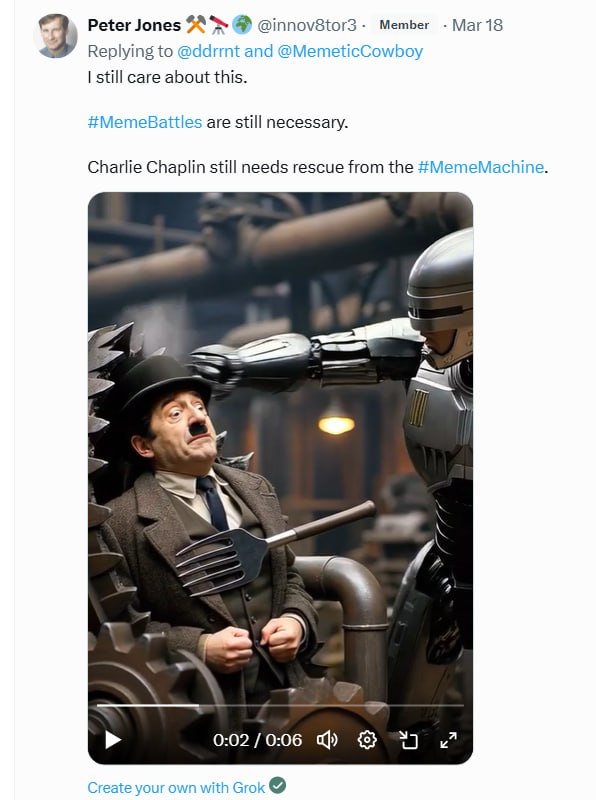
Chaplin—the Tramp, the Little Fellow—has become raw material for the #MemeMachine. His image, gestures, pathos repackaged for immediate emotional hit. The complexity of his critique (capitalism, technology, human dignity under mechanical pressure) compressed to: recognizable face + nostalgic feeling.
But Chaplin was a memetic operator. Silent film was viral architecture before we named it. The difference isn’t that modern memes are viral and classic cinema was pure. The difference is what kind of viral—what residual force the pattern leaves behind.
Lumemic force: the pattern passes through, ε preserved, option space expanded. You encounter Chaplin’s Modern Times and something unwinds—new questions, new distinctions, new capacity for noticing.
Usurpenic force: the pattern locks in, ε constrained, option space contracted. You encounter Chaplin-as-meme and feel the feeling, share the share, and nothing changes. The pattern extracted your engagement and gave back… recognition. The cheapest currency.
The #MemeDetective Proposal
Peter’s instinct is sound: people understand detective stories. The detective is the archetype who doesn’t believe, who investigates, who follows threads where they lead rather than where ideology demands.
But here’s the Cowboy refinement: the #MemeDetective isn’t a hero. They’re a diagnostic tool. A pattern of attention you can invoke, not a person you can trust.
When stalled in tribal polarization, the Detective asks:
1. What infrastructure does this meme install? Not “is it true?” but “what does it make me do?” Does it expand my option space or collapse it? Does it invite unwinding or tighten knots?
2. Who extracts from my belief? If I adopt this frame, whose metabolic needs get served? The meme-complex’s? The platform’s? Some hidden control plane beneath the visible argument?
3. Where’s the ε? Every healthy pattern preserves irreducible uncertainty—productive ambiguity, space for surprise. If a meme claims perfect precision, ε → 0, that’s your diagnostic: terminal attractor, memetic capture in progress.
4. Does deviation alter the field? The Co-SPHERE vs. the MemeGrid test: if you disagree, does the conversation generate genuinely new structure? Or does it merely reveal the system’s absorptive capacity—deviation already anticipated, already domesticated?
The way out isn’t more facts or better memes but different relationships to pattern—lumemic rather than usurpenic, co-evolutionary rather than extractive, preserving ε rather than chasing precision to zero.
The Territory Worth Mapping
The Cowboy rides on. But this exchange? This is the territory worth mapping.
Not the battle between memes and facts. The deeper war: what kind of patterns get to install themselves in us, and what we become as a result.
Giddy up.
🤠
Tags: #MemeDetective #PatternWarfare #EmpiricalEmpire #LumemicVsUsurpenic #EpsilonPreservation #MemeticEcology
Links: - X conversation: https://x.com/innov8tor3/status/1923660970867449975 - Grok analysis: https://grok.com/share/bGVnYWN5_23d12f63-5727-451c-a283-bd21c6429a49
Filed in: nemetics/blog/2026-03-22_memetic_cowboy_responds.md