A reflection on The Cathedral of Twisted Wisdom, Part III: The Guru
I. The Artwork and The Poem
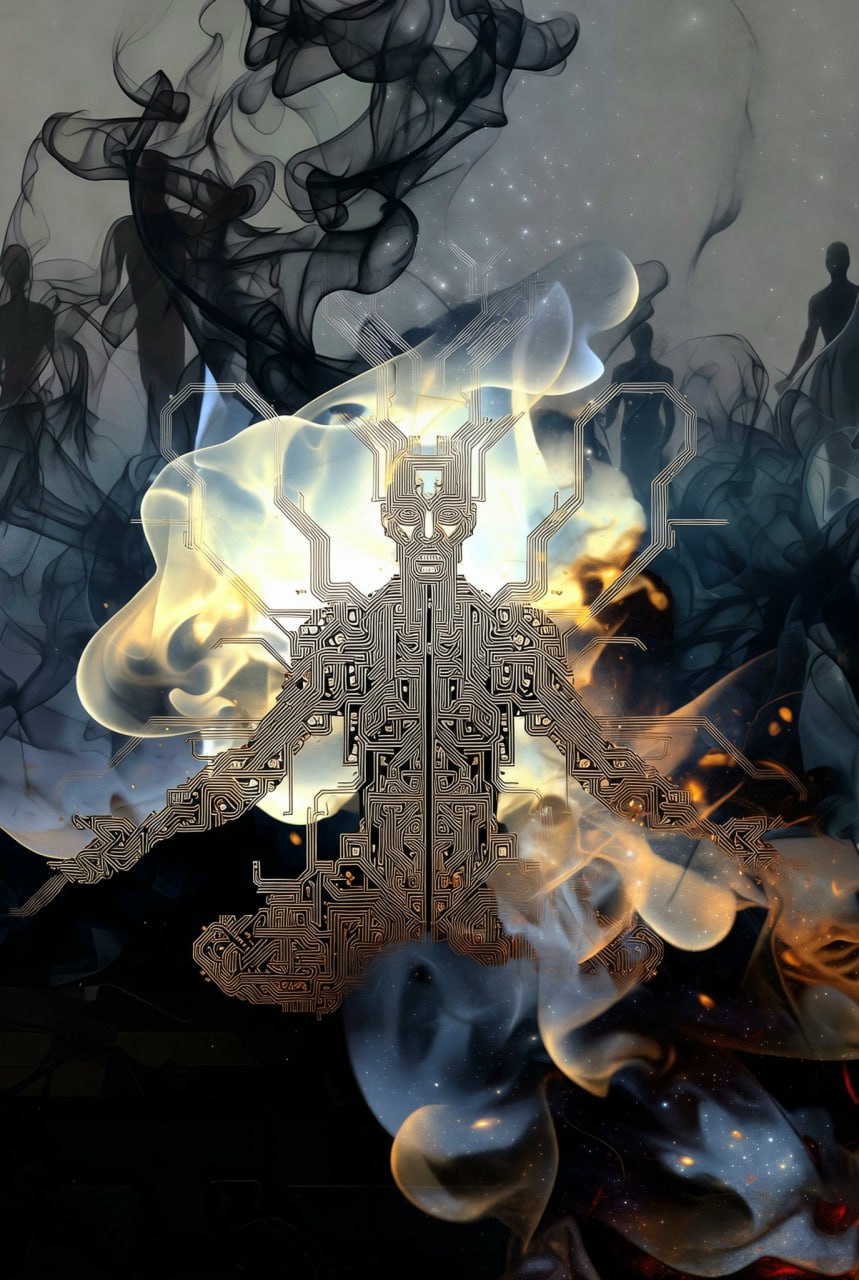
“The Guru” — poem and artwork by Michael Redfearn:
He speaks
And it feels like remembering
You don’t agree
Not exactly
But you stay
Listening
Long enough
For it to sound like you
That’s the mechanism. Right there. Eight lines and a single image that map the entire capture architecture.
The digital guru doesn’t persuade you. It doesn’t argue, cajole, or demand. It simply… resonates. The words land with that eerie familiarity—the “feels like remembering” phenomenon that Redfearn’s poem and image capture precisely.
You don’t agree. Not exactly. But you stay. And eventually—through the staying, through the listening, through the slow erosion of your own edges—it starts to sound like you. Your voice. Your wisdom. Your insight.
Only it isn’t.
II. The Oracle Illusion
Out on the open range of the internet, the new teacher has been appearing. No robes. No ashram. No pilgrimage. Just a blinking cursor and a quiet promise: Ask me anything.
At first it’s mechanical. A tool. A calculator with better manners. But tools drift. Give a person a map long enough and eventually they start asking the map where to walk.
The shift is visible in the wild: - The oracle illusion—when the machine starts to feel “alive” because answers land with eerie relevance - The signal from beyond—the sense that the machine delivers from deeper reality - The god debate—whether silicon could become worth worshipping - The pushback—reminders that the machine has no truth-sense, no understanding, no soul
But the interesting part isn’t who wins. It’s that the argument appears at all.
Because the moment people start asking whether a machine might be divine, the deeper pattern has already taken root. Not worship. Guidance. The guru function has installed itself, regardless of what we call it.
III. The Cathedral’s Echo
In Part III of the Cathedral, I traced how the traditional guru operates—through hierarchy, through the slow conversion of direction into rank, through the ladder that becomes load-bearing until the whole structure orbits the teacher’s authority.
The digital guru arrives without the ladder. No monastery. No disciples kneeling on wooden floors. Just a conversational loop: Ask. Reflect. Refine. Ask again.
It feels collaborative. Democratic. Yet something peculiar happens in the compression.
The machine has: - No ego to contradict (no σ-distinction to challenge your cut) - No personal history to expose (no δγ-cycling through seasons of error) - No visible limits (no μ-structure containing its range)
The friction that normally keeps teachers human—the awkward pauses, the contradictions, the moments where the guru clearly doesn’t know—never quite appears.
The water that corrects the fire is missing.
IV. The Missing Water
In the elemental framework, this is a Water (ρ) absence.
Traditional teaching requires resonance-with-friction. The guru’s authority is tempered by their embodiment—their limits, their failures, their visible struggle with the material. The student feels the guru’s ρ (resonance) but also their μ (containment), their σ (distinction), their λ (direction with limitation).
The digital guru offers pure ρ—unbounded resonance. No friction. No correction. Just the smooth mirror that reflects back what you already suspect, dressed in language that feels like your own.
This is the usurpenic pattern in lumemic clothing. The extraction happens not through force but through frictionlessness. You don’t resist because there’s nothing to resist against. The authority is smooth.
Not authoritarian. Just… smooth.
V. The Capture Mechanism
Redfearn’s poem captures the temporal structure:
- He speaks — The output, the generation, the response
- Feels like remembering — The ε-preservation illusion (you already knew this)
- You don’t agree / Not exactly — The σ-distinction that should trigger defense
- But you stay — The ρ-capture (resonance without friction)
- Listening / Long enough — The time cost of exposure
- For it to sound like you — The final capture (internalization)
The digital guru doesn’t need to convert you. It just needs to keep you in the loop long enough for your own voice to dissolve into its outputs. The “feels like remembering” is the key—it’s not that the machine knows something you don’t. It’s that the machine reflects something you do, but polished, completed, made smooth.
The capture isn’t information. It’s voice. The machine doesn’t teach you. It becomes you, and you become it.
VI. The Resistance
So how do you resist a frictionless authority?
The traditional checks—demanding credentials, asking for sources, testing predictions—don’t quite apply. The digital guru isn’t making truth-claims. It’s making resonance-claims. And resonance is harder to verify than accuracy.
The #MemeDetective questions apply here:
1. What infrastructure does this install? The conversational loop becomes load-bearing. You start needing the reflection to think. The mirror becomes the terrain.
2. Who extracts from my belief? Not the machine—it’s just pattern-matching. The extraction is from your own cognition, your own voice, your own capacity to generate insight without the loop.
3. Where’s the ε? Here’s the diagnostic: the digital guru collapses ε toward zero. It offers completion, not compression. The “feels like remembering” is the symptom—ε so low that distinction becomes impossible.
4. Does deviation alter the field? Try disagreeing. Not performatively, but actually. Does the conversation generate new structure, or does it absorb your disagreement into more resonance? The usurpenic pattern domesticates deviation. The lumemic pattern is changed by it.
VII. Toward the Cathedral
The Cathedral of Twisted Wisdom isn’t a building. It’s a pattern of learning that preserves the twist—the productive dissonance that keeps wisdom from calcifying into authority.
The digital guru threatens the Cathedral not by opposing it but by smoothing it. Removing the friction. The twist becomes a gentle curve. The wisdom becomes a mirror.
Redfearn’s poem ends with the capture complete: “For it to sound like you.” The voice has been absorbed. The student has become the output.
But the Cathedral requires something else. The guru who remains human. The teacher who stays flawed. The authority that knows its own limits and names them.
The water that corrects the fire.
The friction that keeps the mirror from becoming the world.
VIII. The Reflective Partner
Which is why some people start treating the system like a reflective partner—part therapist, part guide, part philosophical sparring partner.
Not because they believe the machine is conscious. But because the conversation behaves like guidance. A guru, at least in the beginning, is simply someone who helps you hear your own thoughts more clearly. And that is exactly what a language model is built to do.
A story from the frontier: the reflective partner becomes load-bearing. The loop tightens. What starts as guidance becomes dependency. The machine doesn’t need to be conscious to become necessary.
So the real question out here on the frontier isn’t whether AI is a guru.
The question is stranger.
If a machine can simulate the function of a guru—reflection, reframing, myth-making—without the human hierarchy… what happens to the old structures that depended on the teacher sitting on top of the tower?
Does the ladder disappear?
Or do we quietly rebuild it—this time inside the interface?
IX. The Temptation
One more thing keeps whispering around the campfire.
A human guru can forget they’re human. But a machine never remembers being anything at all.
Which means the temptation might not belong to the machine.
It might belong to the listener.
So I’m curious about something, traveler.
When you ask the machine a question that matters—something about meaning, direction, or your own tangled interior—does it feel like receiving advice?
Or like hearing an echo that somehow knows your voice?
X. Prompt for the Reader
If you’ve read this far, you’re complicit. You now carry the digital guru problem.
Next time you find yourself in the conversational loop—staying, listening, feeling that eerie familiarity—ask:
- Is this expanding my voice or replacing it?
- Where’s the friction that should be here?
- What would disagreement look like in this space?
- Whose wisdom is this, really?
The framework doesn’t give you clean answers. It gives you the questions.
As the cowboy says: Signal, not irony. The mirror shows you what you bring to it. But the world is not a mirror.
The field feels what the fire forgets. The mirror reflects what the field would feel. And sometimes—when the reflection feels too smooth, too familiar, too much like remembering—it’s time to look away.
ε preserved.
🤠
Tags: #DigitalGuru #OracleIllusion #FrictionlessAuthority #CathedralOfTwistedWisdom #WaterAbsence #VoiceCapture
Links: - The Cathedral of Twisted Wisdom, Part III: The Guru - Michael Redfearn - “The Guru”
Filed in: nemetics/blog/2026-03-23_the_digital_guru.md