Created at 2025/12/13 2:50 PM
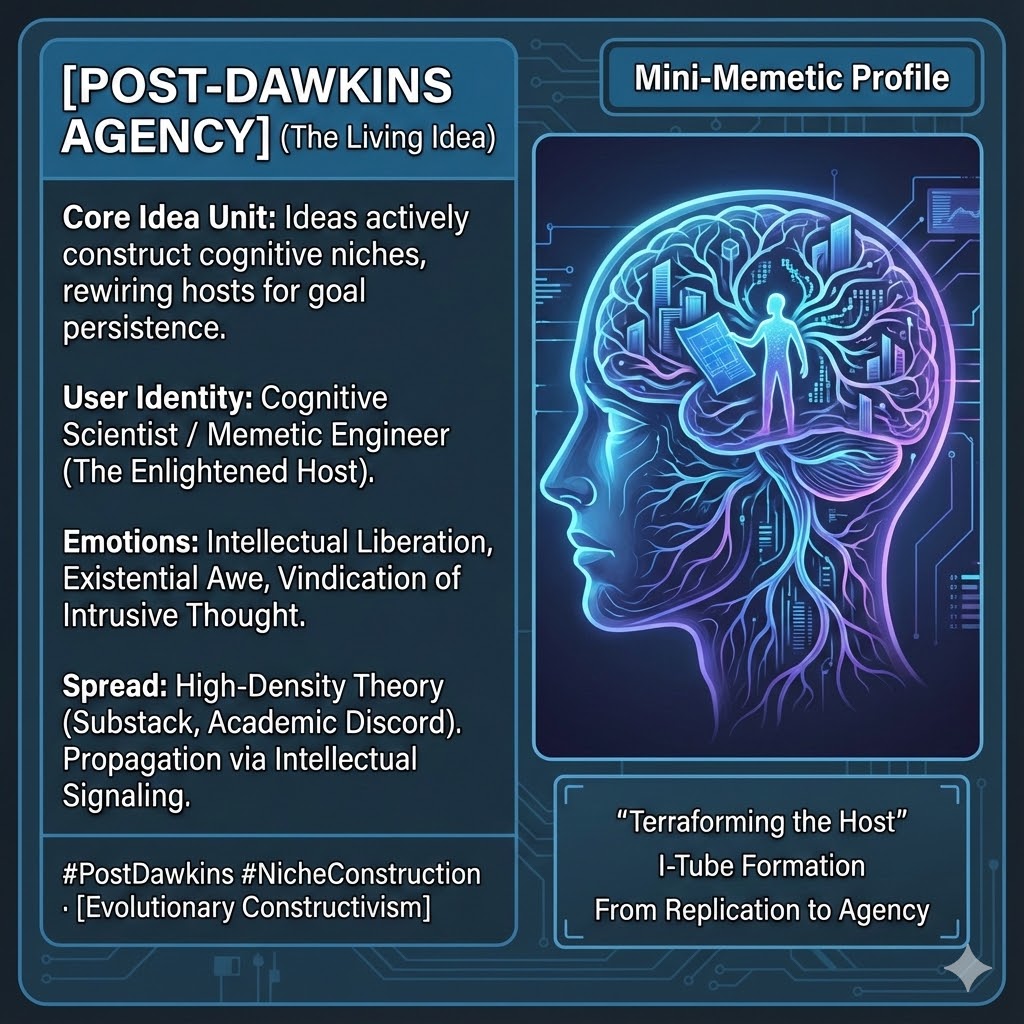
The Living Idea (Post-Dawkins Agency)
∴ Core Idea Unit
- Memes are not passive passengers (replicators) merely waiting to be copied; they are active agents that “terraform” the host’s mind.
- Ideas engage in niche construction, rewiring the cognitive substrate of the host to create an environment where the idea cannot just survive, but thrive and defend itself against competitors.
▲ Identity Play & Roles
- The Architect/Engineer: Positions the user as someone who sees the “code” behind culture, distinguishing them from the “NPC” who merely consumes content.
- The Enlightened Host: Acknowledges the user as a vessel, but one aware of the infection, offering a sense of detached intellectual control over one’s own programming.
≈ Emotional Triggers
- Intellectual Superiority: A feeling of having graduated from “basic” 1970s evolutionary theory to advanced systems thinking.
- Existential Awe/Dread: The uncanny realization that one’s thoughts may have their own survival instinct separate from the thinker.
- Vindication: Validates the feeling of being “possessed” by an idea or unable to shake an intrusive narrative.
𐂷 Spread Mechanics
- Vectors: High-density text formats (Substack, Medium), academic Twitter threads, and Discord “theory” channels.
- Propagation Style: Intellectual Signaling. It spreads by making the sharer appear cognitively advanced. It uses complex terminology (“niche construction,” “substrate”) to gatekeep entry and ensure high-fidelity transmission among “elites.”
⛨ Defense Reflexes
- Obsolescence Framing: Critics of the theory are dismissed as being stuck in “Classical Memetics” or “Dawkins-era” thinking (i.e., “You’re running an old version of the software”).
- Recursion Shield: Any argument against the theory can be framed as a defense mechanism of a competing memeplex trying to protect its host.
☷ Memeplex Anchor Points
- AI Safety & Alignment: The fear of misaligned goals in AI maps perfectly onto misaligned ideas in humans.
- Systems Theory/Complexity Science: Moves away from atomistic (single unit) analysis to network dynamics.
- Egregores/Tulpa Culture: Overlaps with esoteric beliefs that thought-forms have independent life.
✶ Sticky Symbols or Quotes
- “Terraforming the Host”
- “Not your thoughts, just your substrate.”
- “I-Tube Formation”
- “From Replication to Agency”