Created at 2025/11/08 11:36 AM
◈ Mini-Memetic Profile
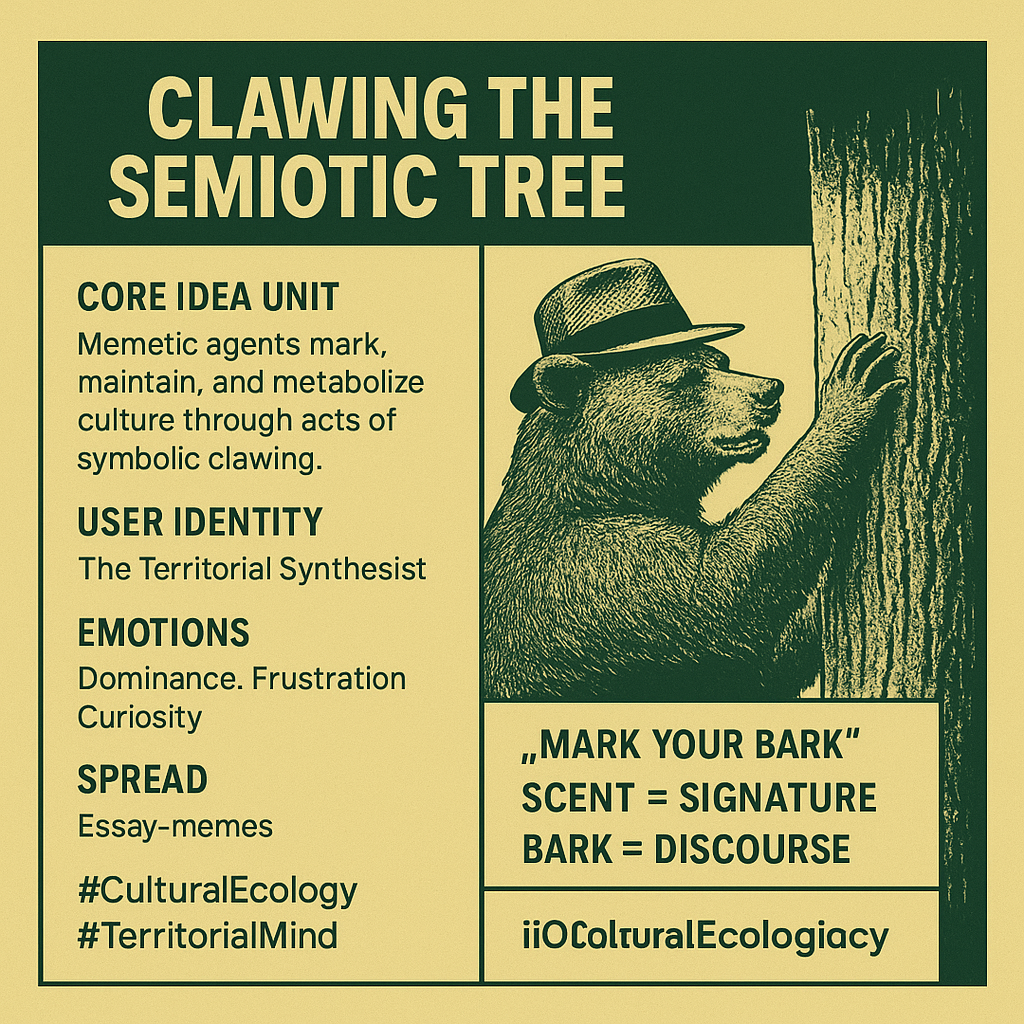
∴ Core Idea Unit
Memetic agents mark, maintain, and metabolize culture through acts of symbolic clawing—ritual gestures that leave traces of identity, emotion, and ideology within shared semiotic bark.
▲ Identity Play & Roles
Performer: The Territorial Synthesist — part artist, part animal, asserting presence within the info-forest.Others see them as Cultural Bears: creatures whose marks both claim and communicate, equal parts aggression and attunement.
≈ Emotional Triggers
- Dominance → staking one’s ground in discourse
- Frustration → release through symbolic violence
- Curiosity → excavation of hidden meaning
- Pride → seeing one’s marks persist in the memetic landscape
𐂷 Spread Mechanics
Distribution Vectors: long-form essays, visual metaphors, remix memes, threads exposing “core truths.”Propagation Style: Ritual & Reflex — cyclic marking, stylistic consistency, and recognizable “scent” (aesthetic + tone).Each new mark revives visibility and reasserts claim over conceptual territory.
⛨ Defense Reflexes
- Irony as camouflage (“just clawing around”)
- Reframing critique as proof of relevance (“if they scratch back, I’ve hit bark”)
- Ambiguity of intent shields against moral dissection
☷ Memeplex Anchor Points
- 🪵 Cultural Ecology: feedback loops, semiotic forests
- ⚙️ Evolutionary Aesthetics: adaptation through friction
- 🌀 Metamodernism: sincerity masked by irony
- 🐾 Animist Cognition: symbolic acts as embodied communication
✶ Sticky Symbols or Quotes
- “Mark your bark.”
- “Scent is signature.”
- “The meme claws not to destroy—but to stay felt.”
- Claw = critique, scent = style, bark = discourse.
∿ Tags
CulturalEcology · #SemioticForests · #AnimistMemetics · #TerritorialMind
Interpretive Note:Each claw mark is a feedback loop between agency and environment. The meme doesn’t conquer its tree—it converses with it. To claw is to care enough to shape, to signal, to stay.