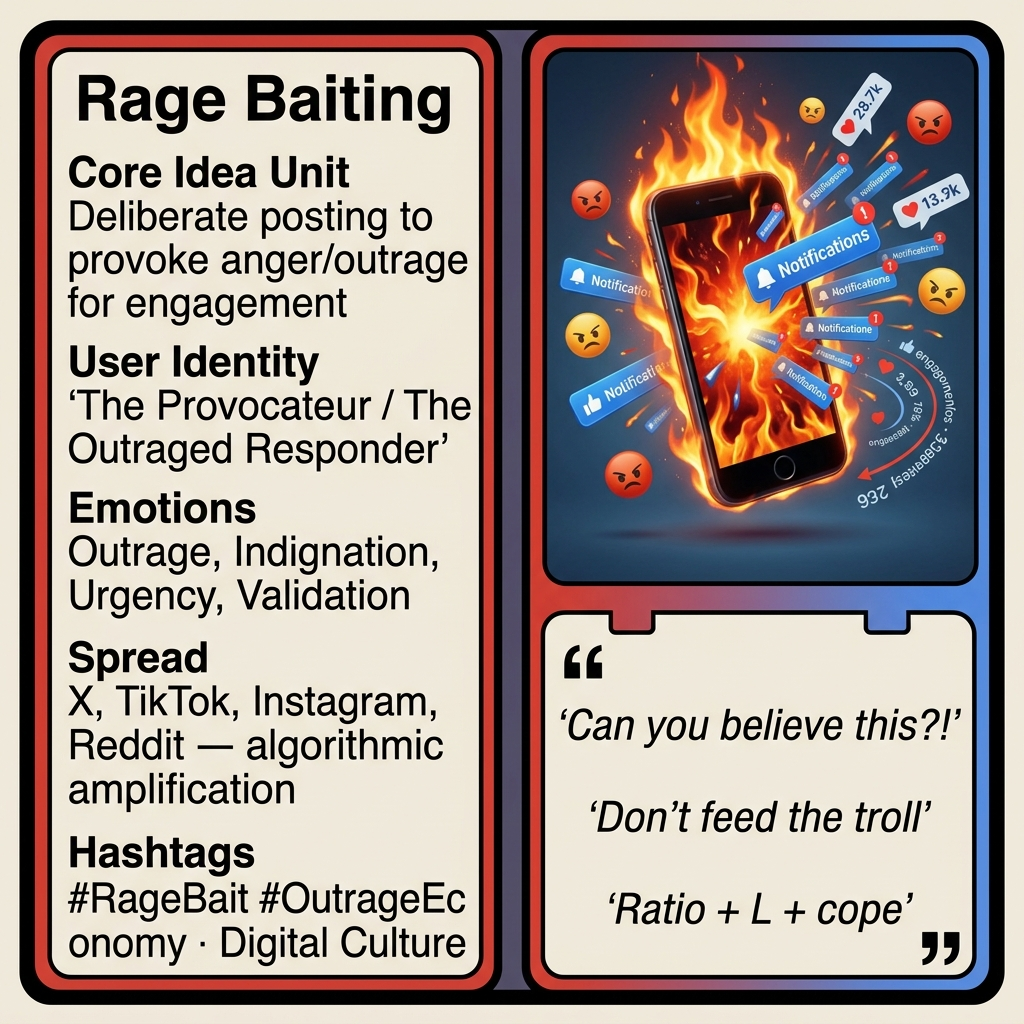
Created at 2026/03/31 4:47 AM
◈ Mini-Memetic Profile
🔶 Rage Baiting — Emotional Manipulation Optimized for the Attention Economy
∴ Core Idea Unit
- Deliberate posting of content designed to provoke strong negative emotions—primarily anger, outrage, or indignation—to drive engagement (likes, comments, shares, views).
- Platforms reward high-engagement content with more visibility through algorithms. Rage triggers powerful emotional responses that flood the system with activity.
- The internet runs on dopamine and cortisol—rage bait delivers both in high doses.
▲ Identity Play & Roles
- The Provocateur: One who masters the art of triggering others, weaponizing engagement for personal gain.
- The Outraged Responder: Feels compelled to correct, shame, or “ratio” the bait—unknowingly fueling the fire.
- The Amplifier: Shares with captions like “Can you believe this?!”—spreading the bait to their own network.
- The Unbothered Troll: Watches chaos unfold with detached amusement, occasionally stoking with emoji replies.
≈ Emotional Triggers
- Outrage — immediate anger at perceived injustice, stupidity, or moral violation
- Indignation — sense of righteous superiority that demands expression
- Urgency — “I need to respond RIGHT NOW” feeling
- Validation — shared outrage creates in-group bonding among responders
- Schadenfreude — enjoyment of watching others lose their minds
𐂷 Spread Mechanics
- Distribution Vectors:
- X (Twitter), Facebook, Instagram, YouTube, TikTok, Reddit
- Algorithmic amplification via engagement signals
- Quote-posting and reply chains
- Tagging friends to share the outrage
- Propagation Style:
- Hot takes with inflammatory absolutes (“All [group] are [trait]”)
- Misleading clips without context
- Virtue-signaling extremes and hypocrisy bait
- Visual shock paired with provocative text
- “Ratio bait” — posting obviously wrong content to trigger corrections
⛨ Defense Reflexes
- Irony shield: “It’s just a joke / satire” when backlash becomes too intense
- Victim framing: “Why are you so sensitive? Can’t take a joke?”
- Engagement laundering: “I’m just starting a conversation”
- Algorithmic invisibility: Poster appears unbothered or amused, deflating direct confrontation
- Scale asymmetry: Individual responders can’t compete with automated/bot amplification
☷ Memeplex Anchor Points
- Attention economy and platform capitalism
- Algorithmic curation and engagement optimization
- Cancel culture and call-out dynamics
- Political polarization and culture war frameworks
- Trolling as recreational activity
- Information warfare and bot-driven manipulation
- Dopamine/cortisol addiction cycles
- “Don’t feed the troll” folk wisdom (paradoxically, spread by the fed)
✶ Sticky Symbols or Quotes
- “Can you believe this?!”
- “This is why we can’t have nice things”
- “Ratio + L + cope”
- “Touch grass”
- “Don’t feed the troll”
- “The internet runs on dopamine and cortisol”
- Flame emoji, clown emoji, skull emoji
- Screenshots of “deleted tweet” or “ratio achieved”