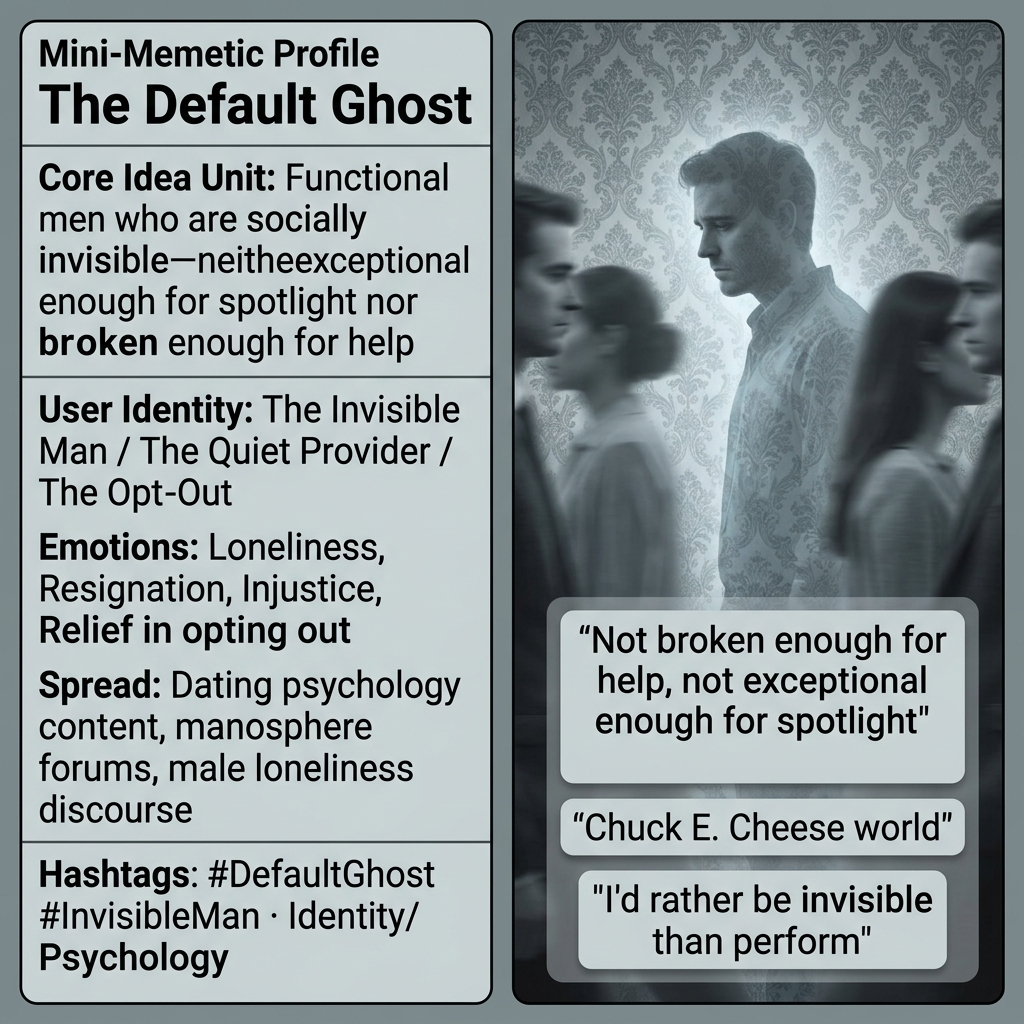
Created at 2026/04/01 8:57 PM
◈ Mini-Memetic Profile
🔶 The Default Ghost — Functional, Unseen, Without Performance
∴ Core Idea Unit
- The “default ghost” describes men who are functional, stable, and self-reliant but socially invisible because they lack performative flair, exceptional status, or visible brokenness.
- In dating app economies and social attention markets, male value is hyper-concentrated at the top (exceptional men get spotlight) or bottom (broken men access help/advocacy). The middle—quietly functional men—receives neither praise for stability nor support for struggles.
- The lament reflects pattern recognition in mismatched incentives: normalcy earns indifference, stability is treated as baseline expectation, and competence without performance registers as absence.
▲ Identity Play & Roles
- The Invisible Man: Decent, functional, reliable—but doesn’t register on attentional radar unless hitting thresholds of looks, status, charisma, or novelty. Psychologists note ~80% of men feel or are treated as “wallpaper” in dating and social contexts.
- The Average Guy: Not broken enough for intervention, not exceptional enough for spotlight. His stability is “expected, nothing worth naming.” Algorithmically or socially filtered out unless he “optimizes” aggressively.
- The Quiet Provider: Bears burdens without recognition, advocacy, or built-in sympathy buffer. Present yet ghostly—structurally present, experientially absent.
- The Opt-Out: Prefers solitude or withdrawal over forced performance, seeing the latter as inauthentic in a “Chuck E. Cheese world” demanding constant curation and spectacle.
≈ Emotional Triggers
- Loneliness — the ache of being surrounded by people who look through you
- Resignation — recognition that effort yields indifference rather than reward
- Injustice — sense that quiet functionality deserves acknowledgment it never receives
- Shame — internalizing invisibility as personal failure rather than structural condition
- Longing — desire to be seen without having to perform, optimize, or dramatize
- Relief (in opting out) — finding authenticity in withdrawal from performance demands
𐂷 Spread Mechanics
- Distribution Vectors:
- Dating psychology content (YouTube, podcasts, Substack)
- Manosphere/red pill forums and adjacent spaces
- Male loneliness literature and mental health discourse
- Dating app critique and “hypergamy” analysis
- Meme culture depicting “NPC” existence or “wallpaper” status
- Propagation Style:
- Self-diagnostic recognition (“this explains my experience”)
- Quote-posting and “this is me” sharing
- Anecdote accumulation (story after story confirming the pattern)
- Defensive reframing (“I’d rather be invisible than clown”)
- Generational lament (“it didn’t used to be this way”)
⛨ Defense Reflexes
- Reframing as virtue: “I’d rather be authentic than performative” (opt-out as moral stance)
- Pathologizing the system: Dating apps create “winner-take-most markets,” not personal failure
- Historical nostalgia: “It wasn’t always this way” (implies temporary condition, not permanent trait)
- Solution-space fragmentation: Debates between self-optimization, opting out, or cultural pushback prevent unified critique
- Dismissal shield: Critics labeled as “incels” or misogynists, allowing the mainstream to ignore structural critique
☷ Memeplex Anchor Points
- Hypergamy and evolutionary psychology frameworks
- Dating app economy and algorithmic filtering
- Attention economy and social media hyper-optimization
- Male loneliness epidemic and mental health crisis
- Decline of social buffers and community structures
- Traditional masculinity in tension with performative modernity
- Empathy asymmetry in gender discourse
- The “Chuck E. Cheese world” (society as forced spectacle)
✶ Sticky Symbols or Quotes
- “Default ghost”
- “Invisible man / wallpaper”
- “Chuck E. Cheese world”
- “Not broken enough for help, not exceptional enough for spotlight”
- “The average guy gets filtered out algorithmically”
- “Quiet functionality with no safety net”
- “I’d rather be invisible than perform”
- “80% of men are treated as invisible”
- Imagery: ghost silhouettes, wallpaper patterns, blurred faces in crowds, empty chairs, solitary figures in busy spaces