Created at 2025/10/29 2:34 PM
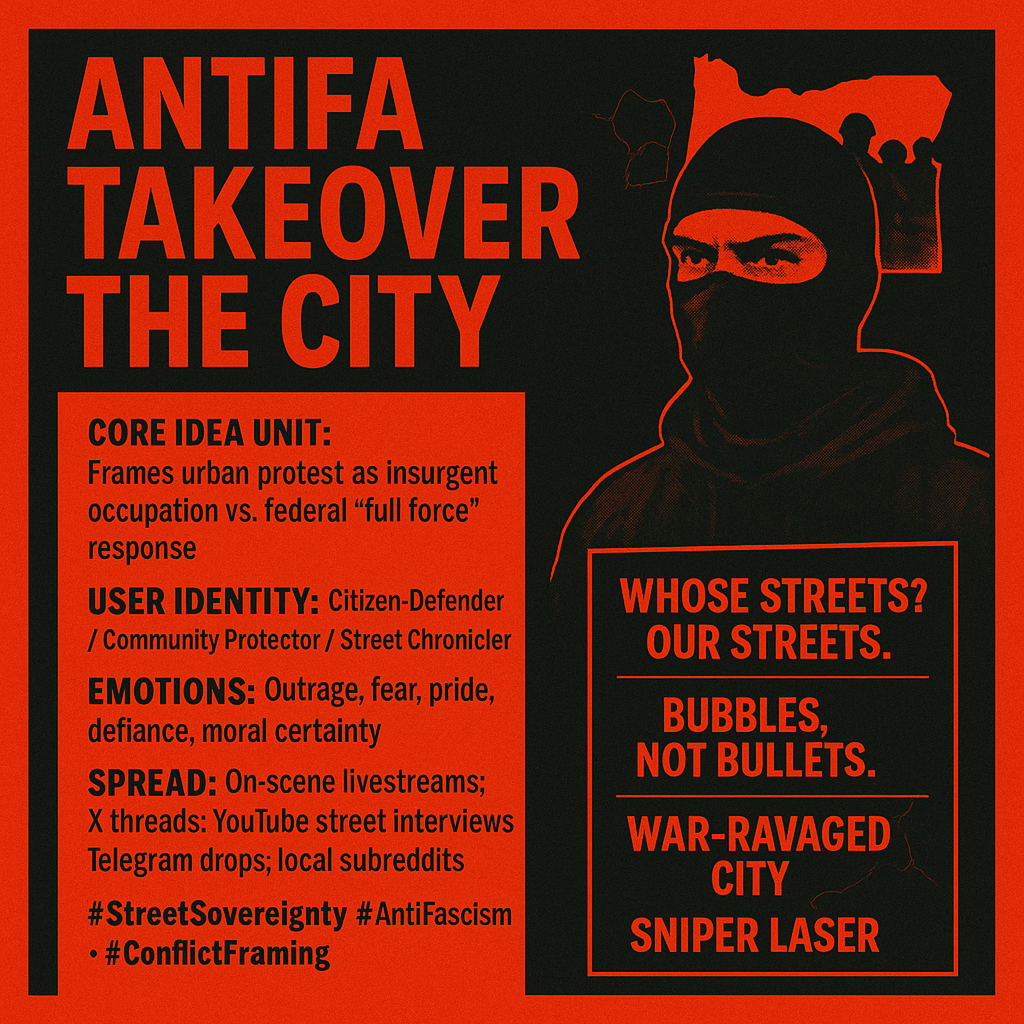
◈ Mini-Memetic Profile
∴ Core Idea Unit
A conflict-frame that casts urban protest as insurgency and federal response as counter-insurgency. The “takeover” narrative reframes decentralized anti-fascist actions as a coordinated occupation, provoking a security logic (“full force”) vs. civil-liberty logic (“protest, not terror”). It tries to shift observers from “dispute over policy” → “existential street war.”
▲ Identity Play & Roles
- Protagonists (Version A): Guardians/Citizen-Defenders protecting the city from “terrorists.”
- Protagonists (Version B): Anti-Fascists/Protectors of Community resisting authoritarian overreach.
- Assigned Antagonist: The Other is whichever side your I-Tube (identity filter) already mistrusts—black-bloc “Antifa” or “militarized feds.”
- Self vs. System: Self becomes frontline agent (witness, streamer, street medic, cop, “boomer with a walker,” masked marcher) set against an illegitimate/overreaching System—or a failing one that must reassert order.
≈ Emotional Triggers
- Outrage & Fear: “Sniper laser,” “terrorist designation,” “war-ravaged city.”
- Moral Certainty: “Anti-fascism is an ideology” vs. “Antifa is an organization.”
- Tribal Pride & Defiance: “Whose streets? Our streets.” “Keep Portland weird.”
- Threat & Martyrdom: “Red line,” “sacrifice,” targeted arrests, pepper balls, gas.Priming: compresses attention into My-Streams of adrenaline (danger), righteousness (defense of community), and humiliation/retaliation loops (clips of scuffles).
𐂷 Spread Mechanics
- Distribution Vectors: On-scene livestreams, clipped verticals, Twitter/X threads, YouTube “man-on-the-street,” Telegram/Discord drops, local subreddits.
- Propagation Style: Shock cuts (sirens, arrests), confrontation vox-pops, irony shields (“Do I look like a terrorist? I’m a boomer.”), label warfare (“terrorist,” “fascist”), aesthetic of black-bloc vs. tactical kit.
- Algorithmic Hooks: Fight-or-flight micro-dramas; “gotcha” debates; night-vision/riot-line visuals; creator ad-reads mid-chaos (monetization loop).
⛨ Defense Reflexes
- Irony & Ambiguity: “Antifa is an ideology, not an org” ⇄ “It’s organized; I know the leader.”
- Preemption: “Media is rage-baiting” ⇄ “You’re hiding violence.”
- Moral Framing: “Community defense” ⇄ “Public safety & law.”
- Proof-by-Clip: Each side curates video shards to inoculate its audience against counter-claims (MemeGrid knotting).
☷ Memeplex Anchor Points
- Security State vs. Civil Liberty (law-and-order conservatism ⇄ protest rights liberalism).
- Urban Mythos & Local Identity (“Keep Portland Weird,” sanctuary city narratives).
- Ideology Labels (anti-fascism, Marxism, “terrorism” designation politics).
- Platform Incentives (creator-economy virality; outrage optimization). Memetic Ecology Zones:
- I-Tube: pre-sets who is “protector” vs “threat.”
- My-Stream: fear/indignation keeps viewers glued.
- We-Sphere: chants/rituals sync group tempo on the street and online.
- Other-Sphere: out-group tagging (“terrorist,” “fascist”) stabilizes conflict.
- Lumeme vs. Usurpene: “Community safety” as lumeme; “invasion/occupation” as usurpene that hijacks the safety frame.🧠 Propagation Tactics (both sides)
- Scene-setting: sunset → riot-police silhouettes → helicopter audio to signal “threshold.”
- Role Conferral: interviewer crowns “leaders,” “warriors,” “boomers,” “MAGA protector.”
- Escalation Beat: announce “they’re coming,” cut to push/pepper balls, then a moral verdict.
✶ Sticky Symbols or Quotes
- “Whose streets? Our streets.”
- “Keep it weird.”
- “Bubbles, not bullets.”
- “Sniper lasered on you.”
- “War-ravaged city.”
- “Red line… sacrifice.”
- Visuals: black-bloc uniforms, umbrellas with slogans, pepper-ball clouds, ICE gate line, handheld gimbals, glow of police vans/helos.